Explore SMA Nitinol Spring Benefits for High-Performance Systems
2026-03-03 18:30:13
In high-performance engineering applications, traditional springs often fail under extreme temperature fluctuations, cyclic loading, or demanding operational environments. Engineers face persistent challenges with material fatigue, permanent deformation, and limited functional versatility. Shape Memory Alloy SMA Nitinol Spring technology offers a transformative solution to these critical pain points. Unlike conventional spring materials, sma nitinol spring components demonstrate exceptional shape memory effect (SME), returning to their predetermined configuration after significant deformation. This remarkable capability, combined with superelastic properties, positions nitinol springs as essential components in aerospace actuators, medical devices, automotive systems, and precision robotics where reliability and performance cannot be compromised.
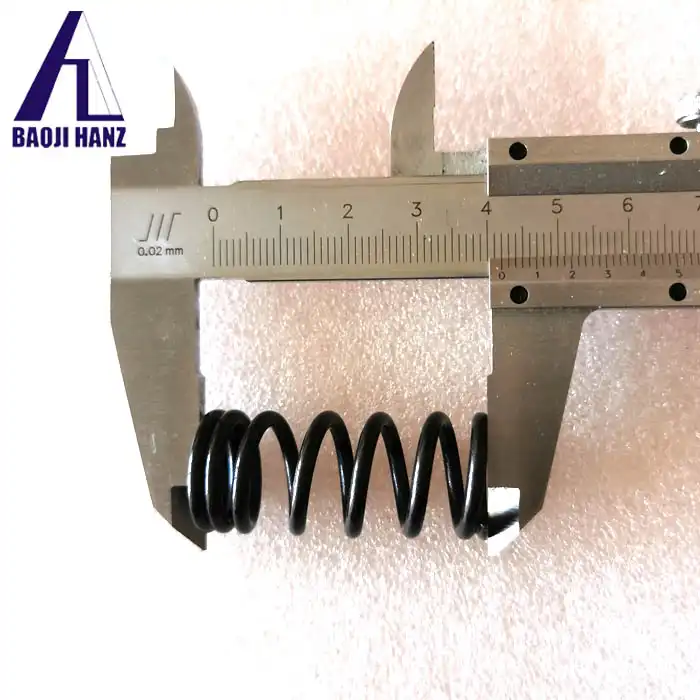
Understanding the Unique Properties of SMA Nitinol Spring Technology
The fundamental advantages of sma nitinol spring technology stem from the extraordinary properties of nickel titanium alloy, specifically the Ni-Ti shape memory alloy composition. The main material component consists of a carefully balanced nickel-titanium alloy with a minimum nickel content of 54%, creating a metallurgical structure that exhibits both shape memory effect and superelasticity. When manufactured to ASTM F 2603 standards, these Shape Memory Alloy SMA Nitinol Spring components demonstrate a density of 6.45g/cm³ and can be precisely engineered with wire sizes ranging from 0.5mm to 3mm, allowing for customized spring configurations tailored to specific application requirements. What distinguishes sma nitinol spring products from conventional spring materials is their phase transformation behavior. At temperatures below the austenite finish (Af) temperature, which typically ranges from -20℃ to 100℃ depending on the alloy processing, the material exists in a martensitic phase that can be easily deformed. Upon heating above the Af temperature range of -20℃ to 10℃, the alloy undergoes a reversible transformation to the austenitic phase, causing the spring to recover its memorized shape with considerable force. This thermomechanical coupling enables sma nitinol spring assemblies to function as both structural components and actuating mechanisms simultaneously, eliminating the need for separate motor systems in many applications. The high strength and ductility inherent in Ti-Ni Alloy compositions ensure that these springs can withstand millions of operational cycles without degradation, far exceeding the fatigue life of stainless steel or music wire alternatives.
Material Composition and Manufacturing Excellence
The production process of sma nitinol spring components follows a sophisticated methodology that ensures consistent quality and performance characteristics. Manufacturing begins with raw material preparation, where high-purity nickel and titanium are precisely alloyed under controlled atmospheric conditions to prevent contamination. The forming processing stage involves specialized wire drawing techniques that achieve the required wire size specifications while maintaining the critical nickel-titanium ratio. Heat treatment and shaping represent the most critical phase, where the spring geometry is established and the transformation temperatures are precisely calibrated through controlled thermal cycling protocols. Surface treatment options including mechanical polishing and pickling processes enhance corrosion resistance and biocompatibility, particularly important for medical applications. Finally, rigorous finished product inspection verifies dimensional accuracy, transformation temperature ranges, and mechanical performance parameters against ASTM F 2603 specifications.
Performance Advantages in Demanding Applications
Engineers selecting sma nitinol spring solutions for high-performance systems benefit from several operational advantages that directly address common engineering challenges. The superelastic behavior of these nickel titanium alloy springs allows them to undergo strains up to 8-10% and still recover completely, compared to the 0.5-1% elastic limit of conventional spring steels. This extraordinary recovery capability means that Shape Memory Alloy SMA Nitinol Spring components can absorb significantly higher energy during impact events without permanent set, making them ideal for vibration damping applications in aerospace structures and automotive suspension systems where space constraints limit the use of larger conventional springs. Temperature-dependent actuation represents another compelling advantage of sma nitinol spring technology. In industrial automation and robotics, these springs can be designed to activate at specific temperatures within the customizable Af temperature range, providing thermally-triggered mechanical responses without electrical control systems. This passive actuation mechanism enhances system reliability by eliminating failure points associated with electronic sensors and controllers. Applications ranging from thermal safety valves to greenhouse ventilation systems leverage this autonomous functionality, where the sma nitinol spring responds directly to environmental temperature changes.
Customization Capabilities for Specialized Requirements
Modern engineering projects increasingly demand components tailored to unique operational parameters, and sma nitinol spring manufacturing processes readily accommodate extensive customization. Spring size specifications can be precisely engineered from micro-scale components for medical stents to larger actuator springs for industrial equipment, with minimum order quantities as low as 100 pieces enabling prototype development and specialized production runs. The customizable transformation temperature range allows engineers to specify exact activation points matched to their application environment, whether that involves cryogenic aerospace conditions or elevated temperature industrial processes. Surface finishing options including mechanical polishing for biomedical implants or pickling for enhanced corrosion resistance in marine environments ensure that each Shape Memory Alloy SMA Nitinol Spring meets the specific operational demands of its intended application.
Quality Assurance and Technical Support Infrastructure
The reliability of sma nitinol spring components in critical applications depends fundamentally on manufacturing quality control and technical expertise throughout the product lifecycle. Companies specializing in nickel titanium alloy production maintain comprehensive quality management systems aligned with ISO9001 standards, supplemented by third-party certifications from SGS and TUV to ensure compliance with international quality benchmarks. These stringent quality control systems encompass raw material verification, in-process monitoring during heat treatment phases, and final performance testing that validates transformation temperatures, mechanical properties, and dimensional tolerances. Production process monitoring documentation retained for a minimum of five years provides complete traceability for aerospace and medical applications where regulatory compliance demands detailed manufacturing records. Pre-sale technical consultation proves essential when engineers first encounter sma nitinol spring technology, as proper material selection and spring design require specialized knowledge of phase transformation behavior and thermomechanical properties. Professional customer service staff and experienced technicians provide guidance on alloy selection, transformation temperature specification, spring geometry optimization, and integration considerations that ensure successful implementation. Order tracking services maintain transparency throughout manufacturing and delivery cycles, reflecting the principles of on-time delivery, high efficiency, and considerate service that distinguish leading manufacturers. After-sales support extends beyond product delivery, with comprehensive usage tracking and ongoing technical consultation that addresses performance questions, application troubleshooting, and potential design refinements based on operational experience.
Applications Across Industrial Sectors
The versatility of sma nitinol spring technology enables deployment across remarkably diverse industrial sectors. In medical device manufacturing, superelastic nitinol springs provide the foundation for self-expanding stents, orthodontic archwires, and surgical instruments that must navigate complex anatomical pathways while maintaining functionality. Aerospace engineers incorporate these springs into deployment mechanisms for satellite solar panels, thermal management systems for avionics, and vibration isolation for sensitive instrumentation. Automotive applications include active aerodynamic components, climate control actuators, and advanced suspension systems where the unique properties of Shape Memory Alloy SMA Nitinol Spring technology deliver performance improvements impossible with conventional materials. Industrial equipment manufacturers utilize these springs in pneumatic and hydraulic systems, robotic grippers requiring adaptive force control, and automated assembly equipment where reliability over millions of cycles justifies the material investment.
Conclusion
SMA nitinol spring technology delivers unmatched performance for high-performance systems requiring superior fatigue resistance, temperature-activated functionality, and exceptional shape recovery. The unique combination of shape memory effect and superelasticity positions these nickel titanium alloy components as essential solutions for demanding engineering applications across medical, aerospace, automotive, and industrial sectors.
Cooperate with Baoji Hanz Metal Material Co., Ltd.
As a leading China sma nitinol spring manufacturer and China sma nitinol spring supplier, Baoji Hanz Metal Material Co., Ltd. brings seven years of specialized expertise in Nitinol Shape Memory Alloy, Superelastic Nitinol Alloy, and Nickel Titanium Alloy production. Our China sma nitinol spring factory offers direct supply with significant cost advantages, maintaining large stock inventories of standard sizes for fast delivery while providing comprehensive OEM customization services for specific alloy compositions, unique geometries, and specialized packaging requirements. Whether you need High Quality sma nitinol spring components or exploring sma nitinol spring for sale options with competitive sma nitinol spring price structures, our China sma nitinol spring wholesale capabilities ensure your project receives precisely engineered solutions. Our ISO9001, SGS, and TUV certifications guarantee product excellence, while our professional technical team provides expert consultation throughout your product development cycle. Contact us at baojihanz-niti@hanztech.cn to discuss your sma nitinol spring requirements and discover how our advanced manufacturing capabilities can enhance your high-performance system designs.
References
1. "Shape Memory Alloys: Properties, Technologies, and Applications" by Dimitris C. Lagoudas, Springer Publishing
2. "Nitinol Shape Memory Alloys: Fundamentals, Processing and Applications" by J. Van Humbeeck and R. Stalmans, Materials Science Forum
3. "ASTM F2063-18 Standard Specification for Wrought Nickel-Titanium Shape Memory Alloys for Medical Devices and Surgical Implants" by ASTM International Committee F04 on Medical and Surgical Materials and Devices
4. "Phase Transformations and Mechanical Properties of Ni-Ti Shape Memory Alloys" by K. Otsuka and X. Ren, Progress in Materials Science
5. "Engineering Applications of Shape Memory Alloys: Design Considerations for Actuators and Sensors" by T.W. Duerig and A.R. Pelton, Proceedings of the International Conference on Shape Memory and Superelastic Technologies