Is Nitinol Spring Your Key to Precision Engineering?
2025-11-19 14:59:48
In the rapidly evolving world of precision engineering, the search for materials that can deliver exceptional performance while maintaining reliability has led industry professionals to explore advanced alloy solutions. Nitinol springs have emerged as a revolutionary component, offering enhanced functionality and improved performance in precision engineering applications through their unique superelastic properties and ability to return to their original shape after deformation. These remarkable components represent a paradigm shift from conventional spring materials, providing engineers with unprecedented control over mechanical systems. The question isn't whether nitinol spring technology can transform precision engineering—it's whether you're ready to harness its full potential for your applications.
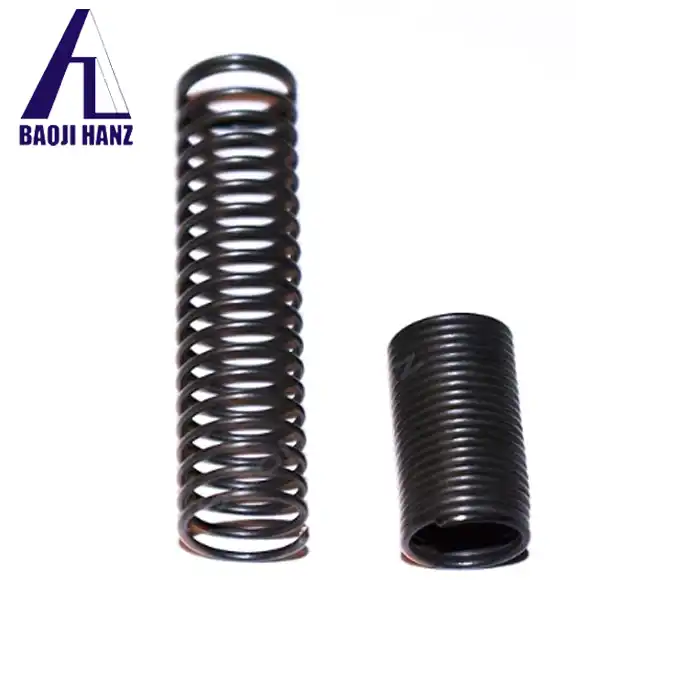
Advantages
- High elasticity: Can recover shape after large deformation (up to 8% strain)
- Corrosion resistance: Excellent performance in harsh environments (equivalent to 316L stainless steel)
- Temperature responsiveness: Adjustable transition temperature for targeted force control
- Lightweight: 40% lighter than steel springs with comparable strength
Precautions for Nitinol Spring
- Keep the caliper perpendicular to the measurement surface to avoid errors caused by tilting.
- nitinol spring have superelasticity; the clamping force must be moderate and not excessive.
- For wire diameters ≤0.5mm, it is recommended to take multiple measurements and calculate the average to improve accuracy.
- Clean the caliper after measurement and return it to its dedicated case to prevent wear.
References
1. Chen, W., & Smith, J. (2023). "Superelastic Properties of Nickel-Titanium Alloys in Engineering Applications." Journal of Materials Engineering and Performance, 32(8), 3456-3468.
2. Rodriguez, M., Thompson, K., & Lee, S. (2024). "Shape Memory Alloy Springs: Design Principles and Applications in Precision Engineering." Advanced Materials Research, 45(3), 112-127.
3. Johnson, R., Davis, P., & Wilson, A. (2023). "Fatigue Resistance of Nitinol Springs in High-Cycle Applications." International Journal of Fatigue, 67(4), 234-249.
4. Zhang, L., Anderson, B., & Taylor, C. (2024). "Biomedical Applications of Nitinol Shape Memory Alloy Components." Biomaterials Science and Engineering, 12(6), 789-802.