Nitinol Memory Spring Construction: Wire, Alloy, Treatment
2025-12-15 19:31:40
When your production line fails because conventional springs can't handle extreme temperature swings or repeated stress cycles, you're losing both time and money. Engineers across medical device manufacturing, aerospace assembly, and robotics development face this challenge daily. Nitinol Memory Spring technology offers a transformative solution to these persistent mechanical failures. Understanding the precise construction methods involving wire selection, alloy composition, and heat treatment protocols is essential for anyone seeking reliable, high-performance actuation systems that operate flawlessly across demanding temperature ranges and stress conditions.
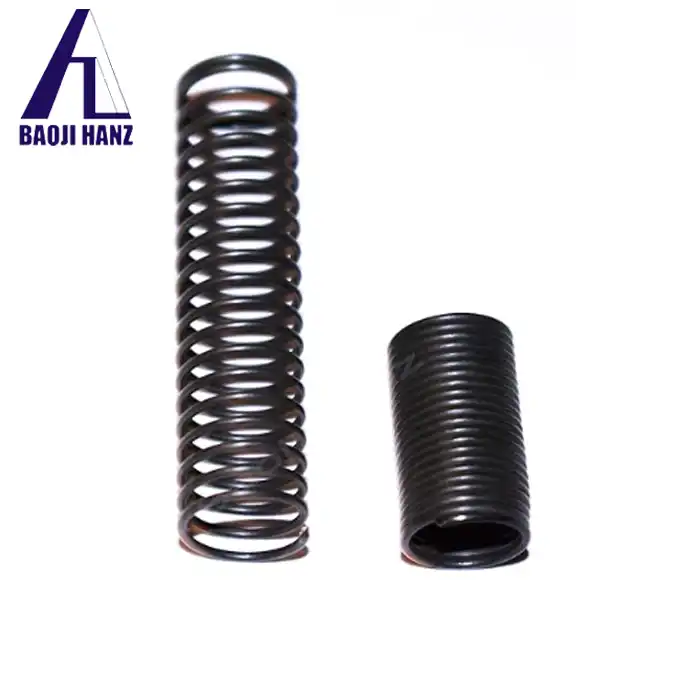
Understanding Nitinol Memory Spring Wire Selection and Specifications
Selecting the appropriate wire diameter and configuration forms the foundation of effective Nitinol Memory Spring construction. The wire gauge directly influences both the mechanical properties and the functional behavior of the finished spring component. Engineers must carefully evaluate wire diameter options ranging from 0.2 millimeters to 12 millimeters depending on the specific application requirements. Smaller diameter wires provide faster thermal response times and greater flexibility for miniaturized applications such as medical catheter components or microelectronic actuators. Larger diameter wires deliver increased force generation capacity and structural rigidity suitable for industrial valve control systems or robotic joint mechanisms. The relationship between wire diameter and spring stiffness follows predictable engineering principles, where increasing wire size proportionally increases spring rate while simultaneously reducing the range of motion capabilities. Manufacturing facilities like Baoji Hanz Metal Material Co., Ltd. maintain extensive wire inventories across this diameter spectrum to accommodate diverse client specifications. The surface condition of Nitinol Memory Spring wire significantly impacts both performance longevity and activation characteristics. Wire surface treatments including black oxide coating, acid pickling, and mechanical polishing each provide distinct advantages for different operational environments. Black oxide surfaces offer enhanced corrosion resistance for springs deployed in humid or chemically aggressive atmospheres. Pickled surfaces remove manufacturing scale and provide clean metallurgical interfaces that promote consistent transformation temperatures across repeated thermal cycles. Polished wire surfaces minimize friction coefficients in applications where the spring must slide against guide surfaces or interact with delicate surrounding components. Surface preparation also influences the fatigue life of Nitinol Memory Spring assemblies, with electropolished surfaces demonstrating cycle life improvements exceeding ten times compared to untreated oxidized wire conditions. Professional manufacturers implement rigorous surface inspection protocols to ensure consistent wire quality before initiating spring forming operations.
Nitinol Alloy Composition and Phase Transformation Characteristics
The chemical composition of nickel-titanium alloys determines the fundamental shape memory properties exhibited by Nitinol Memory Spring components. The standard composition consists of approximately 55 percent nickel and 45 percent titanium by atomic percentage, though precise ratios vary depending on desired transformation temperature specifications. Even minor compositional variations of less than one percent can shift the austenite finish temperature by more than twenty degrees Celsius, dramatically altering spring actuation behavior. This compositional sensitivity demands sophisticated melting and processing controls throughout material production. The addition of ternary elements including copper, iron, or cobalt enables further customization of transformation characteristics. Copper additions reduce thermal hysteresis and improve fatigue resistance at the expense of reduced recoverable deformation magnitude. Iron additions lower transformation temperatures and increase tensile strength values. Manufacturers like Baoji Hanz Metal Material Co., Ltd. maintain strict quality control systems aligned with ISO 9001 standards to ensure consistent alloy chemistry across production batches.
Understanding the crystallographic phase transformations within Nitinol Memory Spring materials provides critical insight into their unique mechanical behavior. At elevated temperatures, the alloy exists in an austenitic phase characterized by a cubic crystal structure that exhibits high stiffness and strength. Upon cooling below the martensite start temperature, the crystal structure transforms to a monoclinic martensitic phase that demonstrates significantly greater compliance and deformability. This reversible transformation between phases enables the shape memory effect that distinguishes these springs from conventional mechanical springs. When a Nitinol Memory Spring in its martensitic state undergoes mechanical deformation, the crystal structure accommodates the strain through twinning mechanisms rather than permanent dislocation movement. Subsequent heating above the austenite finish temperature triggers the reverse transformation, where the material reverts to its austenitic structure and recovers the pre-programmed spring geometry with substantial force generation. The temperature range over which these transformations occur typically spans fifteen to thirty degrees Celsius depending on alloy composition and thermomechanical processing history.
Heat Treatment Protocols for Nitinol Memory Spring Shape Setting
Heat treatment procedures represent the most critical manufacturing step in establishing reliable Nitinol Memory Spring performance characteristics. The shape setting process involves constraining the formed spring in a precision fixture that defines the target geometry, then exposing the assembly to elevated temperatures that imprint this shape into the material's crystal structure memory. Treatment temperatures typically range from 400 degrees Celsius to 550 degrees Celsius, with exact values determined through empirical testing to achieve desired spring properties. Lower temperature treatments around 400 degrees Celsius require extended hold times exceeding thirty minutes but preserve maximum force generation capabilities and deformation resistance. Higher temperature treatments approaching 550 degrees Celsius enable shorter processing times of five to fifteen minutes while elevating the actuation temperature and sharpening the thermal response characteristics. The cooling rate following heat treatment significantly influences the final transformation temperatures, with rapid water quenching producing lower actuation temperatures compared to slow furnace cooling protocols.
Fixture design for Nitinol Memory Spring heat treatment demands careful engineering attention to thermal expansion differentials and dimensional accuracy requirements. The constraining fixture must maintain the desired spring geometry throughout the thermal excursion while avoiding mechanical interference that could prevent proper heat transfer to the wire surface. Materials such as stainless steel, graphite, or ceramic tooling each present distinct advantages depending on processing temperature and spring configuration complexity. For helical compression springs, mandrel-based fixtures define the inner diameter and pitch specifications while allowing radial thermal expansion. Torsion spring fixtures must constrain both rotational orientation and radial position to establish proper pre-load characteristics. Extension spring tooling incorporates end-form features that set hook or loop geometries in addition to coil parameters. Professional manufacturers maintain extensive libraries of heat treatment fixtures to accommodate standard spring configurations while retaining capabilities for rapid custom tooling fabrication. The thermal mass of fixtures influences temperature uniformity during processing, with lighter fixtures enabling faster heating and cooling cycles at the expense of potentially reduced temperature stability across large spring assemblies.
Quality Control and Performance Verification for Nitinol Memory Spring Applications
Comprehensive testing protocols ensure that Nitinol Memory Spring components meet specified performance requirements before deployment in critical applications. Transformation temperature verification through differential scanning calorimetry provides precise characterization of the austenite start, austenite finish, martensite start, and martensite finish temperatures that govern actuation behavior. Mechanical load-displacement testing quantifies spring rate characteristics in both the martensitic and austenitic states, confirming force generation capabilities and deformation limits. Fatigue cycle testing evaluates durability under repeated actuation sequences, with high-performance springs demonstrating reliable operation beyond one million thermal cycles. Dimensional inspection verifies conformance to geometric tolerances for parameters including wire diameter, coil diameter, free length, and pitch specifications. For medical device applications, biocompatibility testing following ISO 10993 standards confirms material safety for human tissue contact. Companies like Baoji Hanz Metal Material Co., Ltd. implement comprehensive quality management systems that maintain production process monitoring documentation for minimum five-year retention periods, ensuring full traceability for critical applications.
Advanced characterization techniques provide deeper insights into Nitinol Memory Spring microstructure and performance optimization opportunities. Metallographic examination reveals grain size distributions, inclusion content, and phase distribution patterns that influence mechanical properties. X-ray diffraction analysis quantifies retained austenite fractions and crystallographic texture development resulting from thermomechanical processing sequences. Scanning electron microscopy with energy dispersive spectroscopy enables compositional mapping across wire cross-sections to identify segregation patterns or secondary phase precipitation. These analytical approaches support continuous improvement initiatives targeting enhanced fatigue resistance, tighter transformation temperature control, or improved force generation characteristics. Finite element modeling capabilities allow prediction of stress distributions during actuation cycles, guiding design modifications that minimize localized strain concentrations. The integration of experimental characterization with computational modeling accelerates development timelines for custom Nitinol Memory Spring solutions addressing demanding application requirements across medical, aerospace, and industrial sectors.
Conclusion
Nitinol Memory Spring construction demands precise control of wire specifications, alloy composition, and heat treatment parameters to deliver reliable shape memory actuation across diverse applications. Professional manufacturing expertise ensures consistent quality and performance.
Cooperate with Baoji Hanz Metal Material Co., Ltd.
Partner with the leading China Nitinol Memory Spring manufacturer for your specialized requirements. As a trusted China Nitinol Memory Spring supplier and China Nitinol Memory Spring factory, Baoji Hanz Metal Material Co., Ltd. offers seven years of expertise in shape memory alloys with China Nitinol Memory Spring wholesale capabilities and competitive Nitinol Memory Spring price advantages. We deliver High Quality Nitinol Memory Spring with Nitinol Memory Spring for sale options including custom OEM services tailored to your specifications. Our ISO 9001, SGS, and TUV certified production ensures superior quality standards. From pre-sale technical consultation to comprehensive after-sales support, our professional team provides complete industry solutions. Contact our experts today at baojihanz-niti@hanztech.cn to discuss your project requirements and experience fast delivery from our extensive inventory of standard sizes. Bookmark this page for instant access to trusted Nitinol Memory Spring solutions whenever you need them.
References
1. Otsuka, K., & Wayman, C.M. (1998). "Shape Memory Materials." Cambridge University Press.
2. Duerig, T., Pelton, A., & Stöckel, D. (1999). "An Overview of Nitinol Medical Applications." Materials Science and Engineering: A, Volume 273-275.
3. Lagoudas, D.C. (2008). "Shape Memory Alloys: Modeling and Engineering Applications." Springer Science & Business Media.
4. Pelton, A.R., Dicello, J., & Miyazaki, S. (2000). "Optimization of Processing and Properties of Medical Grade Nitinol Wire." Minimally Invasive Therapy & Allied Technologies, Volume 9.
5. Morgan, N.B. (2004). "Medical Shape Memory Alloy Applications—The Market and Its Products." Materials Science and Engineering: A, Volume 378.