Nitinol Memory Spring Properties: Durability, Fatigue, Heat
2026-02-27 18:06:31
When critical mechanical systems fail unexpectedly due to spring fatigue, the consequences can be devastating—from medical device malfunctions during surgical procedures to aerospace component failures at altitude. Traditional metal springs crack under repetitive stress, corrode in harsh environments, and lose their mechanical integrity when exposed to temperature fluctuations. This is precisely where Nitinol Memory Spring technology revolutionizes performance expectations. Understanding the exceptional durability, fatigue resistance, and heat response characteristics of Nitinol Memory Spring components becomes essential for engineers and procurement specialists seeking reliable solutions for demanding applications where conventional materials consistently fall short.
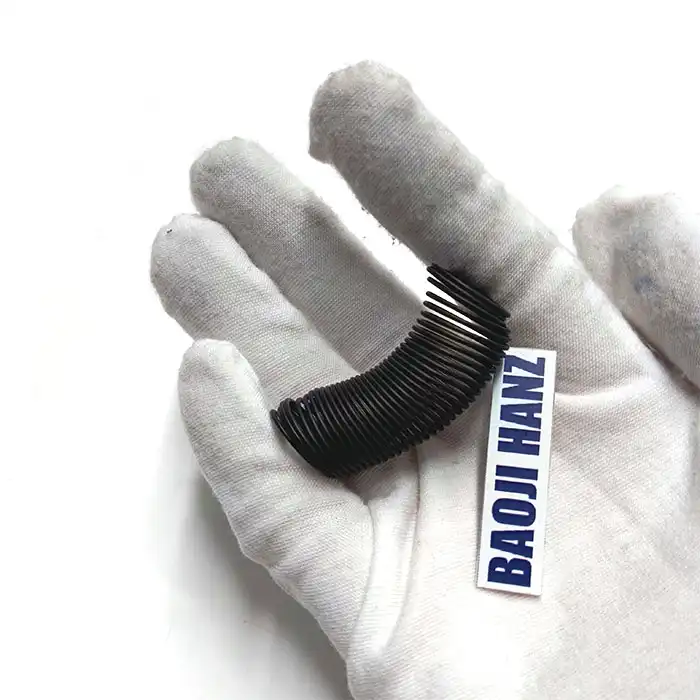
Understanding Nitinol Memory Spring Material Composition and Fundamental Properties
The foundation of Nitinol Memory Spring performance lies in its precisely balanced nickel-titanium alloy composition, typically consisting of approximately fifty-five percent nickel and forty-five percent titanium by atomic composition. This specific ratio creates a material with density of six point four five grams per cubic centimeter, providing an optimal balance between lightweight characteristics and mechanical strength. The alloy composition directly influences the transformation temperatures that enable both shape memory effect and superelastic behavior. Manufacturing processes at Baoji Hanz Metal Material Co., Ltd. carefully control this composition to achieve consistent material properties across wire gauges ranging from zero point two millimeters to twelve millimeters diameter. The crystalline structure of Nitinol Memory Spring material undergoes reversible phase transformations between martensite and austenite phases, which is fundamental to understanding its unique mechanical behavior under varying temperature and stress conditions. The material strength of Nitinol Memory Spring components reaches approximately one thousand fifty megapascals, substantially exceeding many conventional spring materials while maintaining extraordinary flexibility. Processing services including bending, welding, decoiling, cutting, and punching can be applied without compromising the inherent shape memory properties when proper thermal management protocols are followed. Surface treatments such as black oxide, pickling, and polishing not only enhance corrosion resistance but also influence fatigue life by removing surface defects that could serve as crack initiation sites. The biocompatibility of Nitinol Memory Spring material makes it particularly valuable for medical applications where direct tissue contact occurs over extended periods. Understanding these foundational material properties enables engineers to predict performance characteristics and select appropriate specifications for targeted applications requiring exceptional reliability under challenging operational conditions.
Crystal Structure and Phase Transformation Mechanisms
The remarkable properties of Nitinol Memory Spring components originate from reversible solid-state phase transformations occurring within the crystalline lattice structure. At lower temperatures, the material exists in a flexible martensitic phase characterized by a monoclinic crystal structure that accommodates significant deformation through twinning and detwinning mechanisms rather than permanent plastic deformation. When heated above the austenite finish temperature, the crystal structure transforms to a rigid cubic austenite phase, forcing the material to recover its memorized shape with substantial force generation. This transformation occurs over a narrow temperature range specific to the alloy composition, typically between negative twenty degrees Celsius and positive one hundred degrees Celsius depending on application requirements. The transformation temperature can be precisely engineered during manufacturing at Baoji Hanz Metal Material Co., Ltd. through careful control of composition ratios and heat treatment protocols. Research indicates that the hysteresis between heating and cooling transformation temperatures typically ranges from twenty to forty degrees Celsius, which influences the design of temperature-activated actuation systems utilizing Nitinol Memory Spring technology.
Mechanical Properties Across Operating Temperature Ranges
The mechanical behavior of Nitinol Memory Spring components varies dramatically across their operational temperature spectrum, requiring careful consideration during application design. Below the martensite finish temperature, the material exhibits relatively low elastic modulus ranging from twenty to fifty gigapascals, allowing significant deformation with modest applied forces. As temperature increases through the transformation range, both stiffness and recoverable force increase substantially as austenite phase content grows within the microstructure. Above the austenite finish temperature, the elastic modulus increases to between forty and ninety gigapascals, and the material demonstrates superelastic behavior with the capacity to recover from strains up to ten percent without permanent deformation. Operating temperature specifications for Baoji Hanz Metal Material Co., Ltd. Nitinol Memory Spring products span from negative two hundred degrees Celsius to positive one hundred degrees Celsius, accommodating diverse environmental conditions from cryogenic aerospace applications to elevated temperature industrial processes. Understanding this temperature-dependent mechanical response enables engineers to optimize spring designs for consistent performance across anticipated service temperature ranges while maximizing the unique capabilities of Nitinol Memory Spring technology.
Exceptional Durability Characteristics of Nitinol Memory Spring Components
Durability represents perhaps the most compelling advantage of Nitinol Memory Spring technology compared to conventional spring materials, with fatigue life exceeding traditional steel springs by factors of ten or more under equivalent loading conditions. The superelastic behavior of Nitinol Memory Spring components allows them to withstand enormous cyclic strains approaching eight to ten percent without accumulating the microstructural damage that rapidly degrades conventional materials. This exceptional fatigue resistance stems from the stress-induced martensitic transformation mechanism that distributes applied loads through reversible phase changes rather than through dislocation motion that causes cumulative damage in conventional metals. Corrosion resistance of Nitinol Memory Spring material surpasses stainless steel in many aggressive environments, particularly in chloride-containing solutions relevant to marine and biological applications. The passive titanium oxide layer that forms naturally on Nitinol Memory Spring surfaces provides robust protection against electrochemical degradation without requiring protective coatings that might compromise mechanical performance. Long-term reliability data from medical device applications demonstrates that properly designed Nitinol Memory Spring components can operate through millions of cycles while maintaining functional properties, making them ideal for applications where replacement is difficult or impossible.
Surface finish quality dramatically influences the durability of Nitinol Memory Spring components, as surface defects serve as stress concentration sites that initiate fatigue cracks under cyclic loading. Electropolishing and chemical polishing techniques employed by Baoji Hanz Metal Material Co., Ltd. remove surface irregularities and create protective oxide layers that enhance both fatigue resistance and corrosion performance. Experimental studies comparing electropolished Nitinol Memory Spring wire to oxidized untreated wire found that electropolished samples survived one hundred thousand loading cycles while untreated samples failed after only five thousand cycles. This twenty-fold improvement in fatigue life demonstrates the critical importance of proper surface preparation for maximizing durability in demanding applications. Heat treatment protocols following surface preparation must be carefully controlled to avoid excessive oxide layer growth that could compromise fatigue performance. The combination of optimized surface finishing, controlled heat treatment, and inherent material properties enables Nitinol Memory Spring technology to deliver unprecedented durability in applications ranging from surgical instruments to aerospace actuation systems where reliability is absolutely paramount.
Comparison with Traditional Spring Materials in Cyclic Loading
When subjected to equivalent cyclic loading conditions, Nitinol Memory Spring components demonstrate superior durability compared to conventional spring materials including carbon steel, stainless steel, and other specialized alloys. Traditional steel springs operating near their design stress limits typically fail after ten thousand to one hundred thousand cycles due to progressive fatigue crack growth from surface and internal defects. In contrast, properly designed Nitinol Memory Spring components operating in the superelastic regime routinely achieve ten million cycles or more before functional degradation occurs. This dramatic difference arises from fundamental differences in deformation mechanisms, with conventional springs accumulating irreversible microstructural damage through dislocation motion while Nitinol Memory Spring technology distributes loads through reversible phase transformations. The absence of permanent plastic deformation in superelastic Nitinol Memory Spring operation prevents the work hardening and eventual crack initiation that limits conventional spring lifetimes. Manufacturing expertise at Baoji Hanz Metal Material Co., Ltd. ensures that Nitinol Memory Spring products achieve the material purity and processing consistency required to realize these exceptional durability advantages in practical applications across medical, aerospace, and industrial sectors.
Environmental Resistance and Long-term Stability
The environmental resistance of Nitinol Memory Spring components provides significant advantages for applications in corrosive or biologically active environments where conventional spring materials degrade rapidly. The naturally forming titanium oxide passive layer on Nitinol Memory Spring surfaces resists attack from chloride ions, bodily fluids, and many industrial chemicals that would rapidly corrode steel springs. This corrosion resistance makes Nitinol Memory Spring technology particularly valuable for marine applications, chemical processing equipment, and medical devices where replacement is costly or impractical. Long-term stability testing of Nitinol Memory Spring components in simulated biological environments demonstrates maintenance of mechanical properties and transformation temperatures over years of continuous exposure. The biocompatibility of Nitinol Memory Spring material has been extensively validated through ISO nine thousand one certification and rigorous testing protocols, confirming its safety for implantable medical devices and surgical instruments. Baoji Hanz Metal Material Co., Ltd. maintains stringent quality control systems including SGS and TUV certifications to ensure consistent environmental resistance across all Nitinol Memory Spring products, providing customers with confidence in long-term performance under demanding service conditions.
Fatigue Resistance and Cyclic Performance of Nitinol Memory Spring Systems
Fatigue resistance represents the defining performance characteristic that distinguishes Nitinol Memory Spring technology from all conventional spring materials, enabling applications previously impossible with traditional mechanical components. The superelastic behavior of Nitinol Memory Spring components allows them to undergo extremely large reversible strains through stress-induced martensitic transformation rather than through elastic deformation of atomic bonds. This transformation mechanism distributes applied loads uniformly throughout the material volume rather than concentrating stresses at grain boundaries and defects where cracks typically initiate in conventional metals. Experimental fatigue testing of Nitinol Memory Spring wire demonstrates survival beyond ten million cycles at strain amplitudes of six to eight percent, whereas conventional spring materials fail catastrophically at similar strain levels after only thousands of cycles. The fatigue life of Nitinol Memory Spring components increases dramatically when operating strains remain below six percent, with some applications achieving over one hundred million cycles without functional degradation. Manufacturing processes at Baoji Hanz Metal Material Co., Ltd. incorporate specialized heat treatments and surface finishing protocols specifically optimized to maximize fatigue performance for critical applications where reliability cannot be compromised under any circumstances.
The relationship between applied strain amplitude and fatigue life in Nitinol Memory Spring components follows well-characterized curves that enable predictive design for specific application requirements. Operating at strain amplitudes below four percent typically enables effectively infinite fatigue life for practical engineering purposes, making Nitinol Memory Spring technology ideal for continuously operating systems. As strain amplitude increases toward eight to ten percent, fatigue life decreases according to power-law relationships similar to conventional materials but with vastly superior absolute performance. Temperature cycling during fatigue loading influences crack initiation and propagation rates, requiring careful thermal management in applications involving both mechanical cycling and temperature fluctuations. The addition of copper to nickel-titanium alloys can reduce transformation hysteresis and improve fatigue properties for specific applications requiring rapid thermal cycling. Quality control protocols at Baoji Hanz Metal Material Co., Ltd. include comprehensive fatigue testing of representative samples from each production lot, ensuring that delivered Nitinol Memory Spring products meet specified performance criteria for demanding cyclic loading applications across diverse industries.
Mechanisms of Fatigue Failure and Prevention Strategies
Understanding the fundamental mechanisms of fatigue failure in Nitinol Memory Spring components enables implementation of design and manufacturing strategies that maximize operational lifetime. Fatigue cracks in Nitinol Memory Spring wire typically initiate at surface defects including scratches, oxide particles, and microstructural irregularities that create local stress concentrations exceeding the transformation stress. Once initiated, cracks propagate through regions of accumulated microstructural damage caused by incomplete stress-induced transformation or stabilized martensite formation during cyclic loading. Prevention of fatigue failure requires elimination of surface defects through electropolishing or chemical polishing processes that remove potential crack initiation sites while creating beneficial compressive residual stresses. Control of inclusion content during material production is critical, as titanium carbide and titanium nickel oxide inclusions serve as internal stress concentrators that reduce fatigue life regardless of surface preparation quality. Heat treatment protocols must balance the competing requirements of setting appropriate transformation temperatures while avoiding excessive grain growth or precipitation that could compromise fatigue resistance. The technical expertise and advanced processing equipment at Baoji Hanz Metal Material Co., Ltd. enable production of Nitinol Memory Spring components with optimized microstructures and surface conditions that maximize fatigue resistance for the most demanding applications in medical devices, aerospace systems, and industrial automation equipment.
Design Guidelines for Maximizing Cyclic Life
Maximizing the cyclic life of Nitinol Memory Spring applications requires careful attention to design parameters that influence stress distributions and transformation behavior during operation. Maintaining applied strains below six percent ensures operation within the superelastic plateau region where stress-induced transformation occurs uniformly throughout the material, minimizing localized stress concentrations that accelerate fatigue damage accumulation. Spring designs should avoid sharp bends or kinks where stress amplification can cause localized yielding even when nominal strains remain within acceptable ranges. The spring convolution diameter specification of at least one point five millimeters for Baoji Hanz Metal Material Co., Ltd. products reflects minimum bend radius requirements for avoiding excessive surface strains during manufacturing and operation. Operating temperature should be maintained sufficiently above the austenite finish temperature to ensure complete superelastic recovery during each loading cycle, preventing accumulation of residual martensite that degrades performance over time. Wire diameter selection influences both achievable force output and fatigue life, with smaller diameter Nitinol Memory Spring wire enabling faster thermal response but potentially limiting maximum cycle count in high-force applications. Comprehensive design support from Baoji Hanz Metal Material Co., Ltd. engineers helps customers optimize Nitinol Memory Spring specifications for maximum reliability in specific application environments while meeting all functional performance requirements.
Thermal Response Behavior and Heat Actuation in Nitinol Memory Spring Applications
The thermal response characteristics of Nitinol Memory Spring components enable unique actuation capabilities impossible with conventional spring materials, making them invaluable for temperature-sensing and thermally-activated mechanical systems. When a deformed Nitinol Memory Spring component is heated above its austenite start temperature, it begins recovering its memorized shape while generating substantial forces that can perform mechanical work against external loads. The force generation during thermal actuation depends on the degree of constrained recovery, with fully constrained springs generating stresses approaching the material yield strength while partially constrained springs produce proportionally lower forces with greater displacement. Actuation speed depends primarily on the rate of heat transfer into the Nitinol Memory Spring mass, which scales with wire diameter and available temperature differential between the heat source and spring. Smaller diameter Nitinol Memory Spring wire responds more rapidly to thermal inputs due to higher surface area to volume ratios, with wires below zero point five millimeters diameter achieving actuation times under one second in many applications. The operating temperature range for Baoji Hanz Metal Material Co., Ltd. Nitinol Memory Spring products from negative twenty degrees Celsius to positive one hundred degrees Celsius accommodates both ambient temperature superelastic applications and elevated temperature shape memory actuation systems across diverse industrial and consumer applications.
Precise control of transformation temperatures through alloy composition and heat treatment protocols enables customization of Nitinol Memory Spring thermal response for specific application requirements. Applications requiring actuation at human body temperature utilize alloy compositions with austenite finish temperatures between thirty and forty degrees Celsius, ideal for minimally invasive surgical instruments and implantable medical devices. Industrial automation applications often specify higher transformation temperatures between sixty and ninety degrees Celsius to prevent inadvertent actuation from ambient temperature fluctuations while enabling reliable activation from controlled heating sources. The hysteresis between heating and cooling transformation temperatures creates a thermal memory effect that maintains actuated positions until active cooling occurs, valuable for latching mechanisms and bistable actuation systems. Two-way shape memory training protocols can create Nitinol Memory Spring components that automatically reset to alternate configurations upon cooling, eliminating the need for external biasing forces in reciprocating actuation applications. Manufacturing capabilities at Baoji Hanz Metal Material Co., Ltd. include custom transformation temperature specification and two-way training services that enable customers to implement sophisticated thermomechanical actuation strategies utilizing advanced Nitinol Memory Spring technology for innovative product development across multiple industries.
Heat Transfer Considerations in Actuation System Design
Effective thermal management represents a critical consideration in Nitinol Memory Spring actuation system design, as heat transfer rates directly determine response times and power requirements. Convective heat transfer from surrounding air or fluid provides the slowest thermal response, with time constants ranging from several seconds to minutes depending on wire diameter and flow conditions. Conductive heat transfer through direct contact with heated or cooled surfaces enables faster response but requires mechanical interfaces that may constrain spring motion or introduce friction losses. Electrical resistance heating provides the most direct and controllable heating method for Nitinol Memory Spring actuation, with power requirements scaling linearly with wire cross-sectional area and desired temperature rise. Current density limitations prevent overheating and localized melting, typically restricting maximum safe current densities to approximately thirty to fifty amperes per square millimeter for continuous operation. Pulse heating techniques enable higher instantaneous power delivery for faster actuation without excessive steady-state heating. Cooling rates generally prove slower than heating rates due to limited heat sink availability, making cooling the rate-limiting step in reciprocating actuation cycles. Design engineers working with Baoji Hanz Metal Material Co., Ltd. receive comprehensive thermal modeling support to optimize Nitinol Memory Spring actuation system performance while ensuring reliable operation within safe temperature limits throughout the entire service life.
Applications Leveraging Thermal Actuation Properties
The unique thermal actuation capabilities of Nitinol Memory Spring technology enable innovative solutions across diverse application sectors where conventional actuation methods prove impractical or impossible. Medical applications utilize temperature-responsive Nitinol Memory Spring components in minimally invasive surgical instruments that deploy to functional configurations upon reaching body temperature, enabling complex procedures through small incisions. Orthodontic applications leverage the gentle, continuous forces generated by Nitinol Memory Spring archwires that activate at mouth temperature to move teeth efficiently while maximizing patient comfort. Aerospace applications employ Nitinol Memory Spring actuators in deployable structures including antenna systems and solar panel arrays that stow compactly during launch and automatically deploy upon exposure to solar heating in orbit. Consumer electronics applications increasingly incorporate Nitinol Memory Spring hinges in foldable mobile devices where superelastic behavior enables millions of fold cycles while maintaining precise positioning. Automotive applications utilize Nitinol Memory Spring actuators in thermal management systems and adaptive aerodynamic components that respond automatically to temperature changes without requiring electrical power or complex control systems. The comprehensive manufacturing capabilities and technical expertise available at Baoji Hanz Metal Material Co., Ltd. support development of custom Nitinol Memory Spring solutions optimized for specific thermal actuation requirements across all these application domains.
Conclusion
Nitinol Memory Spring technology delivers unparalleled performance through exceptional durability, superior fatigue resistance, and unique thermal response characteristics that enable applications impossible with conventional spring materials. The combination of shape memory effect, superelastic behavior, and corrosion resistance creates mechanical components capable of surviving millions of operating cycles while maintaining precise functional performance across extreme temperature ranges.
Cooperate with Baoji Hanz Metal Material Co., Ltd.
Baoji Hanz Metal Material Co., Ltd. stands as your premier China Nitinol Memory Spring factory, China Nitinol Memory Spring supplier, and China Nitinol Memory Spring manufacturer, offering seven years of specialized expertise in Nitinol Shape Memory Alloy, Superelastic Nitinol Alloy, and Nickel Titanium Alloy development. As a leading China Nitinol Memory Spring wholesale provider, we deliver High Quality Nitinol Memory Spring solutions with competitive Nitinol Memory Spring price advantages through our direct supply capabilities. Our extensive stock ensures fast delivery of standard sizes while our comprehensive OEM services provide customized solutions precisely tailored to your specifications. We maintain ISO nine thousand one, SGS, and TUV certifications, guaranteeing that all Nitinol Memory Spring for sale products meet the highest international quality standards. Our professional technical team provides expert consultation throughout your project lifecycle, from initial design through production monitoring with documentation retained for five years, followed by comprehensive after-sales support tracking product performance and delivering complete industry solutions. Contact our team today at baojihanz-niti@hanztech.cn to discuss how our advanced manufacturing capabilities and technical expertise can transform your Nitinol Memory Spring applications into reality.
References
1. Buehler, William J. and Wang, Frederick E., "Discovery and Development of Nitinol Shape Memory Alloys," Naval Ordnance Laboratory Technical Report.
2. Duerig, Thomas W., Melton, Kevin N., Stockel, Dieter, and Wayman, C. M., "Engineering Aspects of Shape Memory Alloys," Butterworth-Heinemann Publishing.
3. Otsuka, Kazuhiro and Wayman, C. M., "Shape Memory Materials," Cambridge University Press.
4. Mammano, Giovanni S. and Dragoni, Eugenio, "Functional Fatigue of Nickel-Titanium Shape Memory Wires Under Various Loading Conditions," International Journal of Fatigue.
5. Morgan, Neville B., "Medical Shape Memory Alloy Applications: The Market and Its Products," Materials Science and Engineering Journal.