The Material Advantages of Nitinol vs. Stainless Steel
2025-11-19 14:59:46
When engineers face the critical decision between materials for high-performance applications, the choice often comes down to traditional reliability versus revolutionary innovation. The Material Advantages of Nitinol vs. Stainless Steel presents a compelling comparison that could transform your next project's success. This comprehensive analysis explores why nitinol wire spring technology is revolutionizing industries from medical devices to aerospace, offering unprecedented performance advantages over conventional stainless steel solutions.
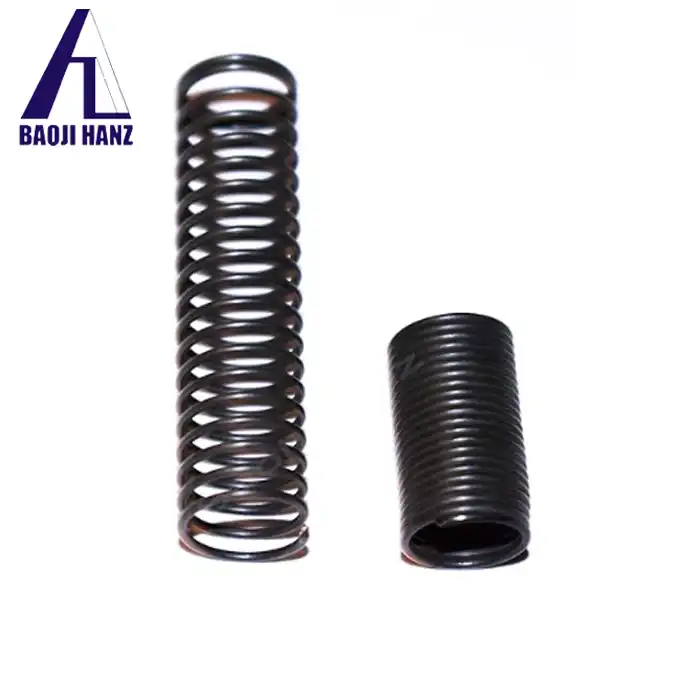
Superior Mechanical Properties of Nitinol Wire Spring Systems
- Superelastic Force Range: 5N - 500N (varies with wire diameter, outer diameter and coil number)
- Shape Memory Force: Triggered by temperature (transition temperature: 0℃ - 100℃), force output stable after activation
- Fatigue Life: ≥10⁶ cycles (under rated load, room temperature)
- Stress-Strain Curve: Flat elastic region (superelasticity) with low hysteresis loss
The fundamental mechanical advantages of nitinol over stainless steel stem from its unique atomic structure and phase transformation capabilities. Nitinol wire is more durable than titanium or stainless steel alloys, allowing it to withstand more demanding or long-term use in medical applications, as well as extreme temperatures in aerospace use. This superior durability translates directly to enhanced performance in nitinol wire spring applications across multiple industries.
-
Superelasticity and Shape Recovery Performance
Nitinol wire spring components demonstrate remarkable superelastic properties that stainless steel simply cannot match. The material can undergo strains up to 8-10% and return completely to its original shape, while stainless steel typically exhibits permanent deformation at strains exceeding 0.2%. This extraordinary elastic recovery makes nitinol wire spring assemblies ideal for applications requiring repeated deformation cycles without material fatigue or permanent set. In many cases, nitinol is substituted in an application which has traditionally used stainless steel. In most cases, the nitinol is substituted to take advantage of its unique superelasticity or shape memory capabilities. The superelastic behavior of nitinol wire spring systems allows them to absorb significantly more energy during loading cycles, providing superior shock absorption and vibration damping compared to traditional stainless steel springs.
-
Temperature-Activated Shape Memory Effects
Unlike stainless steel, nitinol wire spring materials possess the unique ability to remember and return to predetermined shapes when heated above their transformation temperature. This shape memory effect occurs typically between 50°C to 100°C, depending on the specific alloy composition. The transformation enables nitinol wire spring actuators to perform complex mechanical functions without requiring external power sources beyond thermal activation. The temperature-sensitive nature of nitinol wire spring components allows for precise control in automated systems. Engineers can design thermal actuators that respond predictably to temperature changes, making them ideal for safety systems, climate control applications, and temperature-compensated mechanisms where stainless steel would require complex mechanical linkages and external control systems.
Enhanced Durability and Fatigue Resistance in Demanding Applications
- Medical: Orthodontic braces, surgical instruments, implantable devices
- Automotive: Vibration dampers, temperature-controlled valves, seat belt components
- Electronics: Connector springs, micro-switch components, battery contacts
- Aerospace: Deployable structures, thermal control elements
Advantages
- High elasticity: Can recover shape after large deformation (up to 8% strain)
- Corrosion resistance: Excellent performance in harsh environments (equivalent to 316L stainless steel)
- Temperature responsiveness: Adjustable transition temperature for targeted force control
- Lightweight: 40% lighter than steel springs with comparable strength
Cooperate with Baoji Hanz Metal Material Co., Ltd.
As your trusted China nitinol wire spring factory, Baoji Hanz Metal Material Co., Ltd. combines seven years of expertise in Nitinol Shape Memory Alloy development with advanced manufacturing capabilities. Our comprehensive quality control system meets ISO9001, SGS, and TUV standards, ensuring superior High Quality nitinol wire spring products. Whether you need China nitinol wire spring supplier solutions, China nitinol wire spring manufacturer partnerships, or China nitinol wire spring wholesale opportunities, our direct supply advantages deliver cost-effective nitinol wire spring for sale at competitive nitinol wire spring price points. Contact our professional team at baojihanz-niti@hanztech.cn for customized solutions and technical consultation.
FAQ
Q: What is the main advantage of nitinol wire spring over stainless steel in medical applications?
A: Superior biocompatibility with reduced thrombogenicity and enhanced fatigue resistance for long-term implant stability.
Q: How does the fatigue life of nitinol wire spring compare to stainless steel springs?
A: Nitinol wire springs can withstand over 10 million cycles at 6-8% strain, while stainless steel typically fails after fewer than 100,000 cycles.
Q: What temperature range activates the shape memory effect in nitinol wire springs?
A: The transformation typically occurs between 50°C to 100°C, depending on the specific alloy composition and heat treatment.
Q: Why is nitinol more expensive than stainless steel initially but cost-effective long-term?
A: While initial material costs are higher, nitinol's superior durability, reduced maintenance, and extended service life provide better total cost of ownership.
References
1. "Shape Memory Alloys: Properties and Applications in Medical Devices" - Duerig, Thomas W., Pelton, Alan R., Journal of Materials Engineering and Performance
2. "Superelastic Behavior of Nitinol Wires and Springs under Cyclic Loading" - Morgan, Neil B., Materials Science Forum
3. "Biocompatibility Assessment of Nitinol versus Stainless Steel in Medical Applications" - Ryhänen, Jukka, International Journal of Biomaterials
4. "Fatigue Properties of Superelastic Nitinol Alloys for Medical Device Applications" - Robertson, Sean W., International Materials Reviews