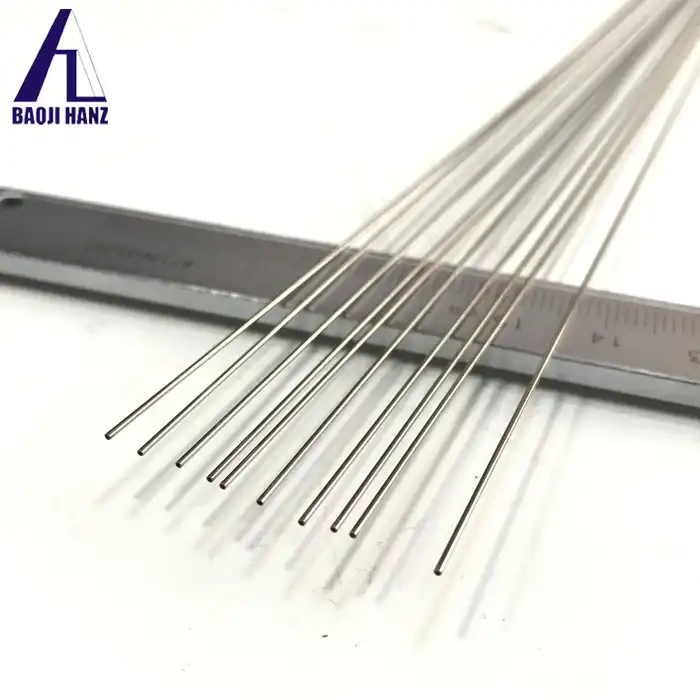
Nickel titanium tube: an innovator of "smart materials" in the medical and industrial fields
In today's rapidly developing medical technology and high-end manufacturing industry, nickel titanium tubes (NiTi tubes), as an intelligent material with revolutionary performance and wide applications, are quietly changing the game rules of traditional industries. From minimally invasive surgical instruments to aerospace components, nickel titanium tubes have become a "universal material" in the eyes of engineers and clinical experts due to their unique superelasticity, shape memory effect, and biocompatibility.
1. The 'superpower' of nitinol pipe: breaking through traditional performance
- Superelasticity and Shape Memory Effect
Nickel titanium tubes can withstand up to 10% reversible deformation under stress and can instantly restore their original shape through body temperature or external heating. This characteristic makes it perform excellently in medical devices such as vascular stents and guide wires, without permanent deformation even through narrow passages, significantly reducing surgical risks.
- Biocompatibility and Corrosion Resistance
The dense TiO₂ oxide film formed on the surface effectively inhibits the release of nickel ions and meets the medical standard ASTM F2063. Long term implantation in the human body poses no toxic risks. Compared to stainless steel, its corrosion resistance has increased by 30%, significantly extending the service life of the equipment.
- Lightweight and High Strength
The density is only 6.5g/cm ³, and the tensile strength reaches 1000MPa, far exceeding titanium alloy and stainless steel, making it an ideal choice for lightweight structures in aerospace.

2. Application scenarios: From human blood vessels to spacecraft
- Precise innovation in the medical field
Vascular stent: A self expanding nickel titanium tube is laser cut into a stent that fits the surface of the blood vessel and releases a constant support force, reducing the postoperative recoil rate by 50%.
Minimally invasive catheter: Anti twisting guide wire can penetrate complex anatomical paths. Companies such as Medtronic and Johnson&Johnson have used it for atrial fibrillation ablation surgery, accurately ablating abnormal myocardium.
Orthopedic implants: Bone plates and screws utilize hyperelastic buffering motion impact, resulting in a 20% increase in postoperative bone healing speed.
- The 'invisible hero' of industry and defense
Aerospace: Used for wing adjusters, high-temperature sealing rings, and can withstand extreme temperature differences of -200 ℃ to 300 ℃.
Precision instruments: Manufacturing flexible sensors and adaptive optics components with a response speed 10 times faster than traditional materials.
3. Technological breakthroughs and market trends
- Manufacturing process upgrade
By adopting the cold drawing+semi crystalline annealing process, combined with laser cutting and electrolytic polishing, the mass production of sub millimeter (φ 0.15mm) thin-walled tubes has been achieved, with a yield rate increased to 98%. The continuous drawing technology has also reduced production costs by 30%.
- market growth potential
The global market size of medical nitinol pipe is expected to reach 274 million US dollars in 2023, and is projected to increase to 406 million US dollars by 2030.
The research and development of ternary alloys such as NiTiCu will further expand their applications in high-end fields.

4. Why choose nickel titanium tube?
- Cost reduction and efficiency improvement: Single surgical instrument loss is reduced by 40%, and maintenance costs are lowered.
- Customized service: Supports diameter customization of 0.8-15mm and variable temperature customization (-5 ℃ to 90 ℃) to meet differentiated needs.
- Global certification and localization support: Through ISO 13485 medical certification, we provide rapid prototype development (1-2 weeks delivery).
5. The future is here: infinite possibilities for nickel titanium tubes
With the aging population and the popularization of minimally invasive surgery, nickel titanium tubes are evolving from "functional materials" to "intelligent solutions". Imagine: self-healing spacecraft components, wearable devices that deform according to body temperature... Nickel titanium tubes are redefining the boundaries of 'materials'.
Email: hztech05@hanztech.cn , Contact us immediately to obtain customized nickel titanium tube solutions and seize the technological dividends!
Click here to explore the infinite value of nitinol pipe